
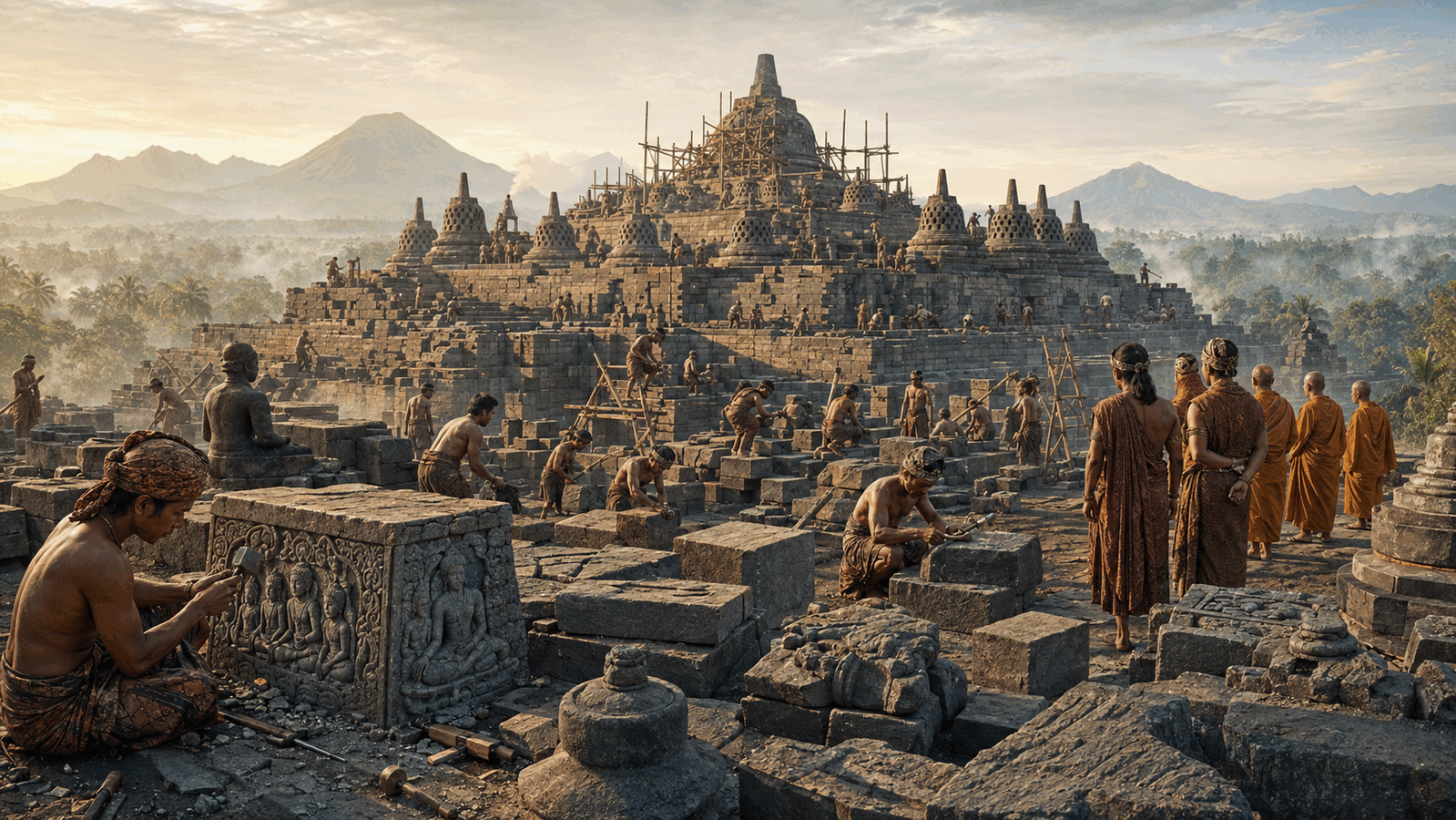
The Borobudur Temple Construction Timeline explains the remarkable process behind the creation of one of the world’s largest Buddhist monuments. Located in Central Java, Indonesia, Borobudur represents the advanced architectural knowledge and spiritual vision of ancient Javanese civilization.
Built during the Sailendra Dynasty, the temple reflects the development of Mahayana Buddhism in Java. Its construction required careful planning, skilled craftsmanship, and a deep understanding of religious symbolism.
8th Century: The Beginning of Construction
The construction of Borobudur began during the 8th century, likely around 750 CE. At that time, the Sailendra Dynasty controlled Central Java and supported the growth of Buddhist culture.
The rulers commissioned the monument as a sacred Buddhist site. The temple was designed to represent the spiritual journey toward enlightenment.
Builders selected volcanic stone as the primary material. They arranged millions of stone blocks to create terraces, stairways, stupas, and detailed relief galleries.
The construction process required advanced engineering methods. Workers shaped and positioned stones without using modern equipment.
Visitors can discover more about this historical monument through Borobudur Temple history, origins, rediscovery, restoration, and legacy.
8th–9th Century: Development of the Temple Structure
During the following decades, builders continued expanding the monument. They carefully developed the temple layout based on Buddhist cosmology.
Borobudur was created with three symbolic sections: Kamadhatu, Rupadhatu, and Arupadhatu.
Lower section represented the world of human desires. The middle terraces represented the transition toward spiritual understanding. The upper terraces symbolized the achievement of enlightenment.
Thousands of relief panels were carved during this period. These artworks displayed Buddhist teachings, moral stories, and scenes from ancient Javanese society.
Early 9th Century: Completion of Borobudur
Historians believe Borobudur was completed in the early 9th century during the reign of King Samaratungga.
After completion, the monument became an important Buddhist pilgrimage center. Monks and visitors traveled to Borobudur for meditation and religious activities.
The temple functioned as a symbolic journey. Pilgrims walked through the terraces while reflecting on Buddhist teachings shown through the relief carvings.
10th–15th Century: Decline and Abandonment
After the decline of the Sailendra Dynasty, Java experienced political and religious changes. The center of power moved toward other regions, and Borobudur gradually lost its original role.
The temple was eventually abandoned. Volcanic materials and tropical vegetation covered parts of the structure for centuries.
Although Borobudur became hidden, local communities continued to recognize its existence and historical importance.
19th Century: Rediscovery and Restoration Efforts
Borobudur was rediscovered in the early 19th century during the British administration of Java. Thomas Stamford Raffles received information about the hidden monument in 1814.
Further research revealed the extraordinary scale and artistic value of Borobudur. However, preservation challenges became increasingly visible.
Early restoration projects were carried out to protect the structure. Later, larger conservation programs improved the stability of the monument.
20th Century–Present: Preservation of a World Heritage Site
A major restoration project was conducted between 1975 and 1982 through cooperation between Indonesia and UNESCO.
The restoration protected Borobudur from structural damage and preserved thousands of stone components.
UNESCO recognized Borobudur as a World Heritage Site in 1991. Today, conservation teams continue monitoring the monument to maintain its historical value.
Travelers who want to explore this ancient masterpiece can join a Borobudur Temple tour to experience its architecture, history, and cultural significance.
Conclusion
The Borobudur Temple Construction Timeline shows the extraordinary journey of an ancient Buddhist monument. From its construction during the Sailendra Dynasty to modern preservation efforts, Borobudur continues to represent Indonesia’s cultural heritage.
Understanding this timeline allows visitors to appreciate the dedication, knowledge, and spiritual meaning behind every stone, terrace, and relief.
